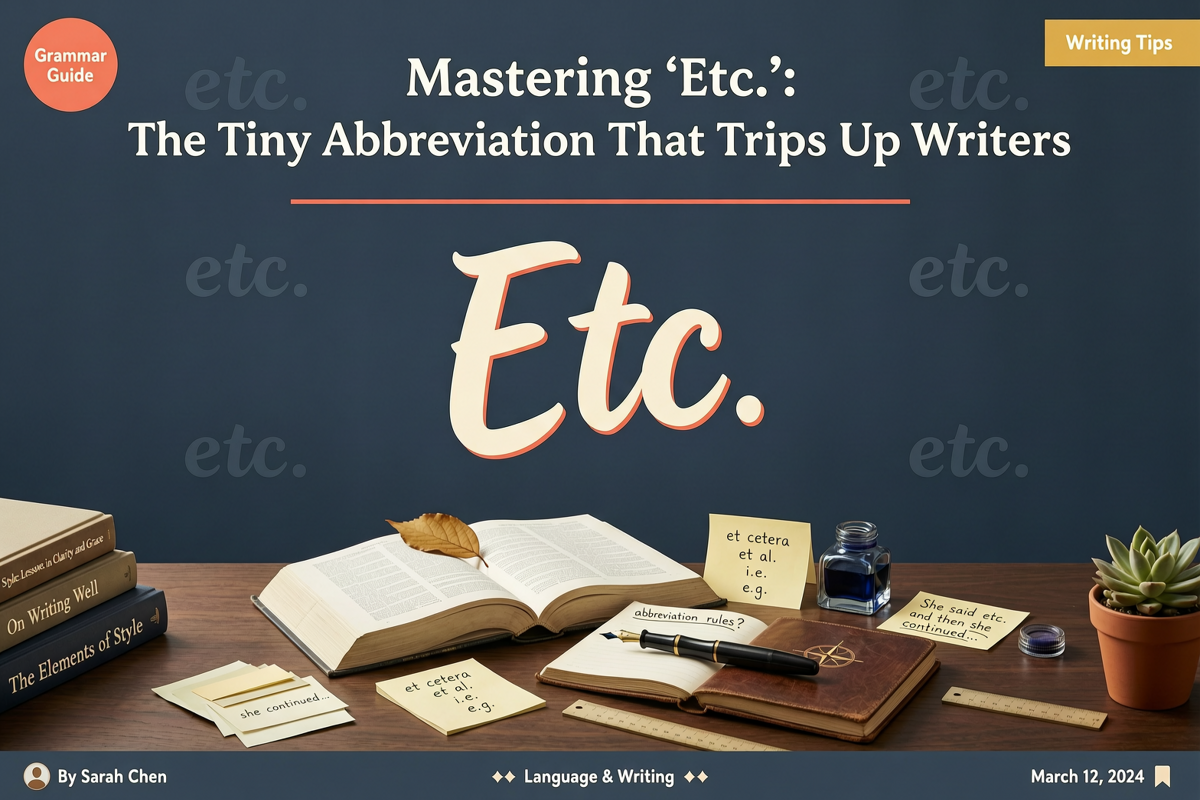
Mastering 'Etc.': The Tiny Abbreviation That Trips Up Writers
Learn the correct use of 'etc.' in English: punctuation, style, common errors, and elegant alternatives to elevate your writing. Perfect your prose now.
Why 'Etc.' Feels So Confusing
In the middle of an otherwise clear sentence, a tiny dot and a trio of letters can bring a seasoned writer to a halt. The abbreviation etc. is one of the most widely used Latin shortcuts in English — and one of the most misused. Misplaced periods, redundant 'and etc.', and the dreaded misspelling 'ect.' turn up in emails, essays, and even published articles. Let's clear the fog.
A Quick History Lesson: Et Cetera
Two thousand years ago, Roman scribes were already looking for shortcuts. They shortened et cetera to 'etc.' and used it in their own documents. The phrase is made of two Latin words: et, meaning 'and,' and cetera, meaning 'the rest.' When you write 'etc.', you are literally saying 'and the rest.' That's exactly what the abbreviation does: it invites your reader to imagine the remaining items of a list without forcing you to type them all.
Correct Spelling and Punctuation
There are three quick rules to remember:
- Spelling: It is always 'etc.' In a flood of typos, 'ect.' is one of the most common. Think of the full Latin phrase and the et comes first. The correct spelling is e-t-c.
- The period: In American English, the abbreviation always takes a period. In British English, some writers drop it and use 'etc' without a dot. Most international style guides still recommend the period, so using 'etc.' is your safest bet in any context.
- Comma after: If the sentence continues after 'etc.', place a comma after the period. Example: 'We packed socks, gloves, scarves, etc., and then we headed out.' This comma might look strange, but it's grammatically spot-on.
Five Common Mistakes with 'Etc.'
Even native English speakers stumble on these five pitfalls. Avoid them and you'll instantly look more proficient.
- 1. 'And etc.' — redundant. Because et already means 'and,' writing 'and etc.' is like saying 'and and the rest.' Drop the word 'and.' It adds nothing and irritates grammar lovers.
- 2. Using 'such as' or 'for example' with 'etc.' The phrase 'such as' already signals a partial list. Adding 'etc.' doubles the uncertainty. 'Fruits like apples, oranges, etc.' is awkward. Choose one: 'fruits like apples and oranges' or 'fruits such as apples, oranges, and others.'
- 3. Using 'etc.' for people. Most style guides suggest avoiding 'etc.' when listing human beings. 'The team includes Maria, John, Akiko, etc.' feels odd because we think of people as individuals, not as categories. Use 'among others' or 'and others' instead.
- 4. Missing the period in informal writing. Even in casual emails, 'etc' without a period looks unfinished. The period is a signal that the word has been shortened. Keep it.
- 5. Using it in formal academic writing. Many professors and academic journals steer clear of 'etc.' because it can be seen as vague and lazy. Instead of saying 'The course covers syntax, semantics, etc.,' write 'The course covers major areas of linguistics, including syntax, semantics, and more.'
When Is 'Etc.' Perfectly Fine?
This tiny abbreviation is not wrong all the time. In everyday emails, blog posts, and casual professional messages, 'etc.' is a convenient and clear shortcut. People understand that you are leaving out a few obvious examples. If you are writing a quick note to a colleague, there is no need to list every item.
However, use it with care. The items you omit should be in the same category as the ones you list. If you write 'I enjoy jazz, sushi, and hiking, etc.,' your reader might wonder what the 'etc.' includes. Does it cover music, food, or outdoor activities? Keep your list homogeneous so the 'etc.' is meaningful.
Elegant Alternatives to 'Etc.'
If you find yourself reaching for 'etc.' too often, consider these alternatives. They can add rhythm and precision to your writing.
- and so on — friendly and conversational.
- and the like — a touch more formal and descriptive.
- among others — ideal for people or specific examples.
- and more — modern and versatile, especially in listicles and product pages.
- and much more — a slightly enthusiastic version of 'and more.'
In formal writing, the strongest alternative is to rewrite the list so it feels complete. For example, 'The store sells apples, pears, and oranges' is concrete. Add 'and other seasonal fruit' if you need to suggest variety.
How to Pronounce 'Etc.'
When you read 'etc.' aloud, the standard pronunciation is et SET-er-uh. Many people say 'ex cetera' or 'ek cetera,' but those are incorrect. If the abbreviation looks like 'et cetera,' then the pronunciation should follow that spelling. Say the word 'et' clearly, then 'cetera' with a hard 'c' as in 'set.' Your pronunciation will sound more polished.
Etc. in the Digital Age
Has the digital age changed how we use 'etc.'? Not really. You see it in texts, social media posts, and emails every day. The abbreviation is alive and well because it solves a universal problem: we rarely have time to list every single idea. Just remember that autocorrect cannot save you from a grammatical error. Rely on your own knowledge, not an app.
Final Thoughts
Mastering 'etc.' is a small but rewarding step in your English journey. It shows that you understand Latin roots, punctuation rules, and the subtle art of clarity. The next time you're about to write 'etc.', stop and ask yourself: Is this the best way to say what I mean? If the answer is yes, write it with confidence. If not, choose a more explicit alternative.
And now you know the rest — literally.