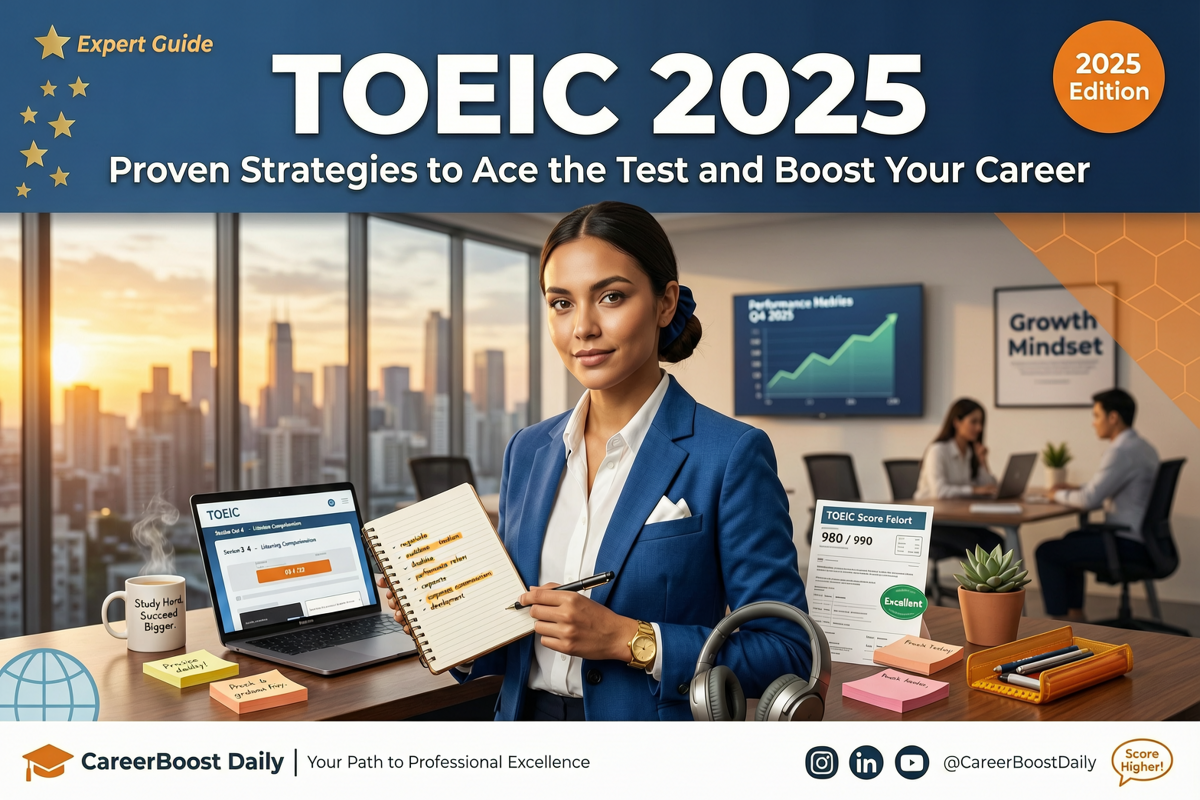
TOEIC 2025: Proven Strategies to Ace the Test and Boost Your Career
Discover effective strategies for scoring high on the TOEIC exam in 2025. Learn key tips for each section, common pitfalls, and how a top score can accelerate your career.
Introduction
The Test of English for International Communication (TOEIC) remains one of the most widely recognized English proficiency exams for professionals worldwide. In 2025, as globalization intensifies, a high TOEIC score is more valuable than ever for career advancement, especially in multinational corporations and industries like finance, IT, and hospitality. Whether you're aiming for a promotion, a new job, or an overseas assignment, mastering the TOEIC can open doors. This comprehensive guide provides proven strategies to help you excel in each section of the exam and leverage your results for professional growth.
Understanding the TOEIC Format
The TOEIC Listening and Reading test consists of two sections: Listening (100 questions, 45 minutes) and Reading (100 questions, 75 minutes). The total score ranges from 10 to 990. Each section is equally weighted. The test assesses everyday English used in a business context, including conversations, talks, emails, and articles. Familiarity with the format is the first step to success.
Listening Section Strategies
Part 1: Photographs
In this part, you see a photo and hear four statements. Choose the one that best describes the image. Tip: Focus on verbs and prepositions. Often, distractors use similar-sounding words or slightly incorrect descriptions. Practice scanning the photo quickly and predicting possible statements.
Part 2: Question-Response
You hear a question and three responses. Strategy: Listen for question words (who, what, when, where, why, how) and choose the response that logically answers the question. Beware of responses that sound related but don't match the question type.
Part 3: Conversations
You hear short conversations between two people, followed by three questions. Tip: Before each conversation, quickly read the questions (they are printed in the test booklet). Underline keywords. Listen for specific information like names, numbers, and actions. Practice identifying the speaker's purpose and the main topic.
Part 4: Talks
You hear a monologue (announcement, message, or speech), followed by three questions. Approach: Similar to Part 3, preview the questions. Focus on the overall context: who is speaking, to whom, and why. Take mental notes of key points.
Reading Section Strategies
Part 5: Incomplete Sentences
Choose the best word or phrase to fill in the blank. These test vocabulary and grammar. Advice: Build your vocabulary by studying common business terms. Review grammar rules for tenses, prepositions, and conjunctions. Use process of elimination to discard obviously wrong options.
Part 6: Text Completion
You read a passage with four blanks. Each blank has four options. Strategy: Read the entire passage to understand the context. Pay attention to surrounding words that may influence the correct answer, such as collocations and sentence structure.
Part 7: Reading Comprehension
This section includes single passages and double passages (two related texts). Questions test main ideas, details, inferences, and vocabulary in context. Tips: Skim the passage first to get the gist, then read questions and scan for answers. For double passages, understand the relationship between the texts (e.g., an email and a reply, an article and a table). Manage your time: don't get stuck on difficult questions.
Common Pitfalls to Avoid
- Overthinking: Trust your first instinct. Many test takers second-guess and change correct answers to wrong ones.
- Ignoring time management: Allocate time per section. For reading, spend no more than 75 seconds per question on average. If a question is taking too long, mark it and come back if time permits.
- Neglecting the answer sheet: Fill in answers carefully. A misalignment can lead to lost points.
- Lack of practice with official materials: Use authentic TOEIC practice tests to simulate exam conditions. This helps build stamina and familiarity.
- Underestimating the importance of endurance: The test lasts over two hours. Take practice tests in one sitting to build focus.
How to Use Your TOEIC Score for Career Growth
In 2025, many employers set minimum TOEIC score requirements for hiring or promotions. For example, a score of 750+ often qualifies for managerial positions, while 900+ is expected for executive roles or positions requiring client-facing communication. Here’s how to leverage your score:
- Include it on your resume and LinkedIn profile. Specify the score and when you took the test.
- Use it in interviews. Mention your TOEIC score as proof of your English ability, especially for roles in international contexts.
- Target industries that value TOEIC. Finance, IT, consulting, and manufacturing commonly require high scores.
- Consider the TOEIC Speaking and Writing tests for a more comprehensive assessment. Many employers now request these as well.
Final Tips for Test Day
Get a good night's sleep, eat a balanced meal, and arrive early. Bring valid ID and your admission ticket. During the test, stay calm and focused. If you feel nervous, take a few deep breaths. Remember, the TOEIC is a measure of your current English ability; it's not a reflection of your worth. With consistent practice and the strategies outlined above, you can achieve the score you deserve.
Conclusion
The TOEIC remains a powerful tool for career advancement in 2025. By understanding the test format, applying proven strategies, and avoiding common mistakes, you can maximize your score. Pair your preparation with real-world English practice—listen to business podcasts, read professional articles, and engage in conversations. Your TOEIC success is within reach. Start preparing today and unlock new professional opportunities.