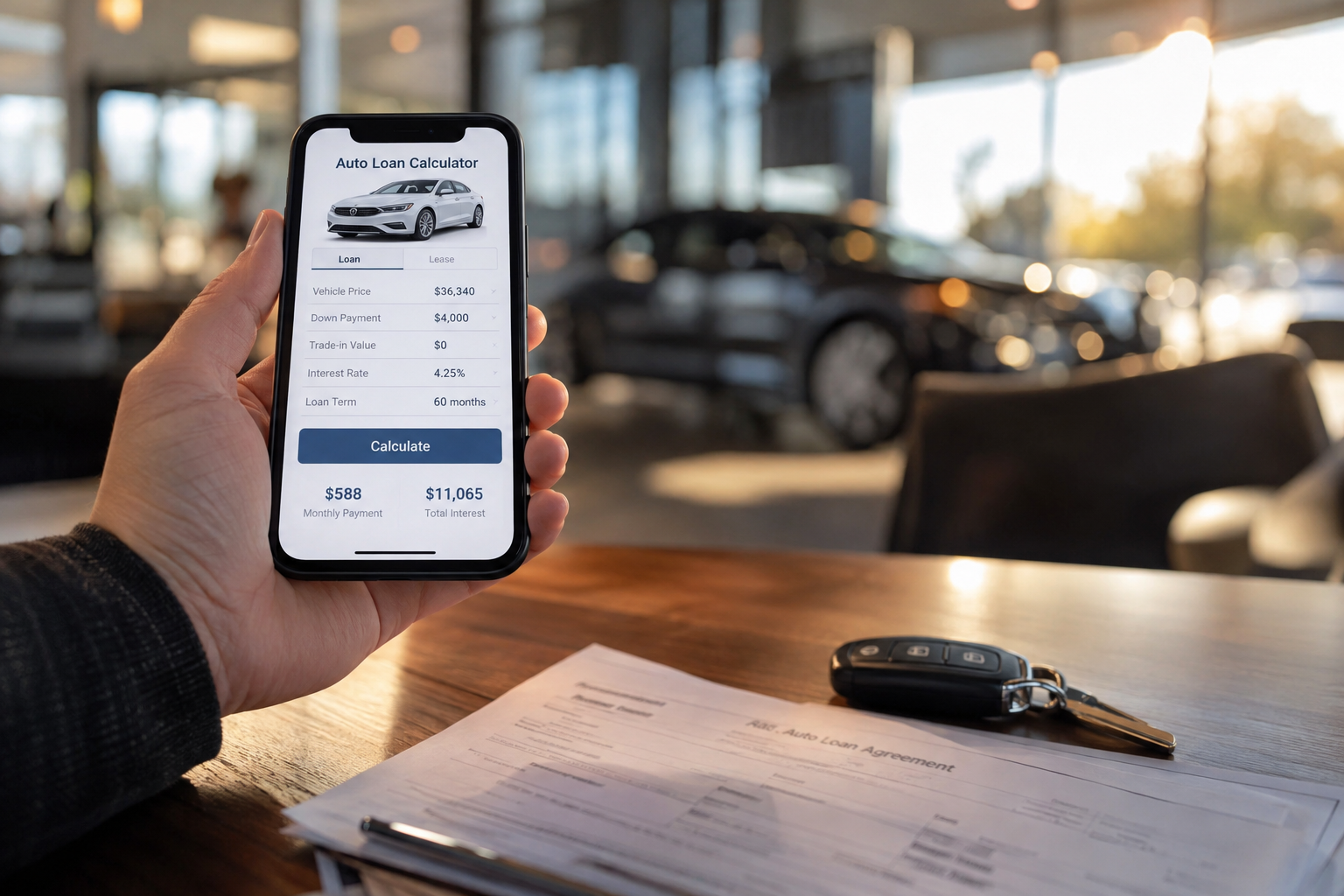
Auto Loan Calculator: What Your Monthly Payment Hides
An auto loan calculator reveals far more than your monthly figure — discover how APR, term length, fees and trade-ins shape what you actually pay.
Why the Monthly Payment Is the Least Useful Number
Dealerships love the monthly payment. It is small, round, and easy to say out loud. But a monthly figure on its own tells you almost nothing about whether you got a good deal. A $420 payment could mean a $23,000 car financed at 4% for five years, or a $31,000 car stretched over seven years at 9%. Same number, wildly different outcomes. An auto loan calculator exists to break that number apart.
What a Calculator Actually Computes
At its core, an auto loan calculator solves a single equation: the present value of a stream of equal payments. You feed it four inputs and it returns the payment that drives the loan balance to exactly zero at the end of the term.
- Loan amount (principal): the price of the car, minus your down payment, minus any trade-in credit, plus tax, title, registration and dealer fees.
- Interest rate: the annual rate on the loan, divided by twelve to get the monthly rate.
- Term: the number of monthly payments — 36, 48, 60, 72 or even 84 months.
- Start date (optional): when the first payment is due.
Everything else — total interest, payoff date, amortization schedule — is derived from those four.
Amortization: Where Your Money Actually Goes
Early payments are mostly interest. On a $27,000 loan at 6.5% for 60 months, the first payment of about $528 sends roughly $146 to interest and $382 to principal. By the final year, that flips almost completely. This matters because it explains why trading in a car after two years often leaves you owing more than the vehicle is worth — the loan has barely moved.
The Inputs That Move Your Payment Most
Term Length
Stretching a loan lowers the payment and raises the cost. The same $27,000 at 6.5% costs about $528 over 60 months, or $454 over 72 months. That is $74 a month in your pocket — and roughly $975 more in interest over the life of the loan. Longer terms also keep you underwater longer, which is risky if the car is totaled or you need to sell.
Rate
Rate is the lever with the least patience. Two percentage points on a $27,000 five-year loan is worth roughly $1,400 in total interest. That is why it pays to check financing from a credit union or bank before you sit down at the dealership — you then have a number to beat.
Down Payment and Trade-In
Every dollar down is a dollar that never accrues interest, and it reduces the risk of being upside down. A common rule of thumb is 20% down on a new car and 10% on a used one, with the loan term capped at 60 months.
APR Is Not the Interest Rate
The interest rate is what you pay on the borrowed money. The APR folds in fees — origination charges, documentation fees, sometimes mandatory add-ons — so it reflects the true annual cost. When comparing two offers, compare APRs, not rates. A lower rate with a $700 origination fee can be worse than a slightly higher rate with no fee, and the calculator output will not show that unless you add the fee to the loan amount.
What Most Calculators Leave Out
- Sales tax: charged on the purchase price, and in some states only on the difference after a trade-in.
- Dealer documentation fees: often $150 to $600, and they get financed too.
- Gap insurance and extended warranties: convenient to bundle, expensive to spread over 72 months.
- Insurance and fuel: not part of the loan, but part of the real monthly cost of ownership.
- Depreciation: a new car can lose about 20% of its value in the first year.
Run the Numbers Before You Shop
Here is a sequence that keeps the negotiation honest. First, decide your maximum monthly payment and your maximum total out-the-door price — not just the sticker. Second, get pre-approved by at least one lender so you know your realistic rate. Third, enter the actual out-the-door number into the calculator using the real term and rate. Fourth, look at the total interest figure, not the payment. If the total interest makes you wince, shorten the term or increase the down payment until it does not.
Negotiate the price of the car first and the financing second. Dealers can move money between the two, and a discount on the sticker often reappears as a higher rate.
A Quick Worked Example
You agree on a $32,000 car. You put $3,000 down and get $2,000 for your trade-in, leaving $27,000 before tax and fees. Your credit union approves you at 6.5% for 60 months. The calculator returns $528 a month and about $4,700 in total interest. Push the term to 72 months and the payment drops to $454, but total interest climbs to roughly $5,700. Take the 60-month loan if you can afford it — the extra $74 a month buys you close to a thousand dollars.
The Bottom Line
An auto loan calculator is not a magic answer machine. It is a translation device that turns a sales pitch into three numbers you can actually judge: the monthly payment, the total interest, and the true price of the car once financing is included. Get those three in front of you before you sign anything, and the negotiation gets a lot simpler.