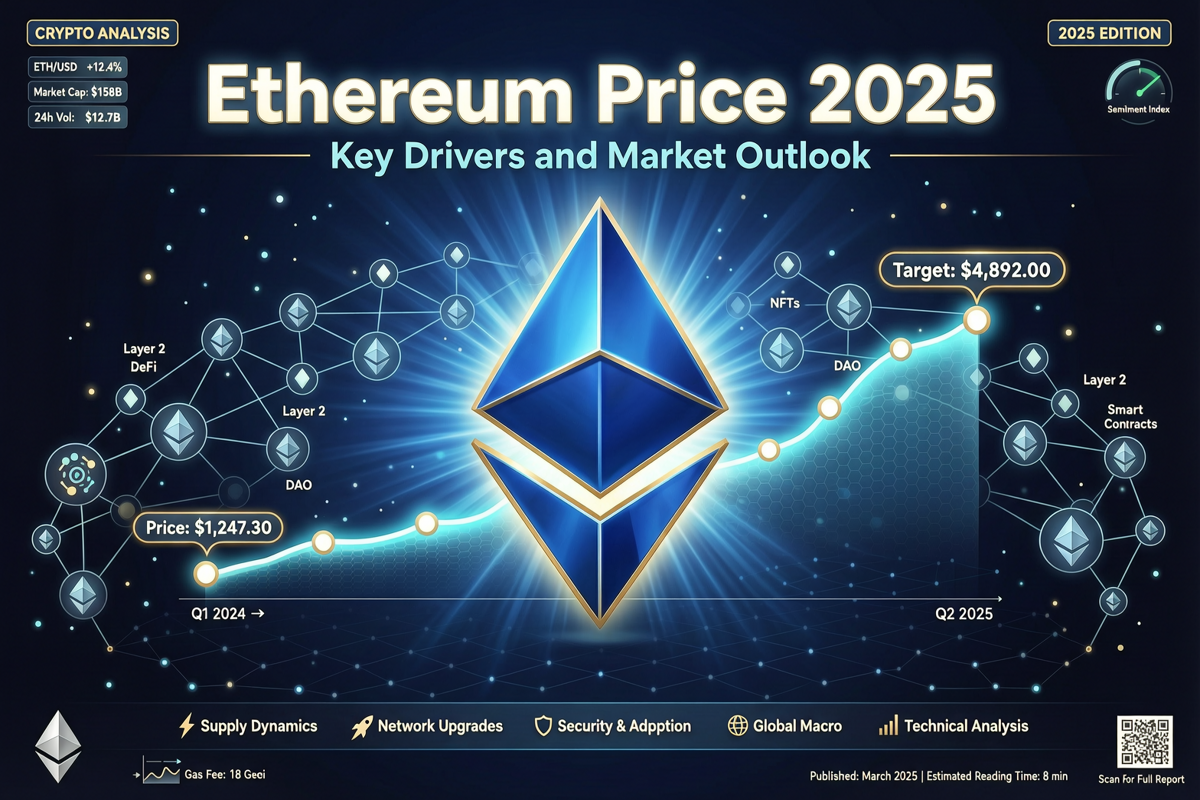
Ethereum Price 2025: Key Drivers and Market Outlook
Explore the key factors shaping Ethereum's price in 2025, including network upgrades, institutional adoption, and macroeconomic trends. Expert analysis and forecasts inside.
Introduction
Ethereum, the second-largest cryptocurrency by market capitalization, continues to be a focal point for investors and developers alike. As we move through 2025, the price of ETH is influenced by a complex interplay of technological advancements, regulatory developments, and broader economic forces. This article delves into the primary drivers behind Ethereum's price action and offers a forward-looking perspective on where the market may be headed.
Network Upgrades and Scalability
Ethereum's transition to proof-of-stake with the Merge in 2022 was a historic milestone, but the journey isn't over. In 2025, the network is undergoing further upgrades aimed at improving scalability and reducing transaction costs. The introduction of sharding and layer-2 solutions like Optimistic Rollups and zk-Rollups are expected to significantly enhance throughput. These improvements could increase Ethereum's utility, attracting more decentralized applications (dApps) and users, which in turn may drive demand for ETH.
EIP-4844 and Proto-Danksharding
A key upgrade on the horizon is EIP-4844, also known as Proto-Danksharding. This proposal introduces a new transaction type that temporarily stores data blobs, making rollups more cost-effective. If implemented successfully, it could lower fees on layer-2 networks, making Ethereum more competitive with faster blockchains like Solana. Lower fees and higher throughput are bullish signals for ETH price, as they expand the network's addressable market.
Institutional Adoption and ETFs
Institutional interest in Ethereum has surged following the approval of spot Ethereum exchange-traded funds (ETFs) in major markets like the United States. These ETFs provide traditional investors with easy exposure to ETH without the complexities of self-custody. In 2025, the inflow of capital from pension funds, endowments, and asset managers is a significant price driver. Additionally, the staking yield offered by Ethereum (currently around 3-5%) makes it attractive for income-seeking institutions, especially in a low-yield environment.
Regulatory Clarity
Regulatory clarity is another critical factor. The classification of ETH as a commodity by the U.S. Commodity Futures Trading Commission (CFTC) has reduced legal uncertainty. However, ongoing debates about securities laws for other tokens and the potential for stricter regulation in Europe or Asia could impact sentiment. A clear, favorable regulatory framework would likely boost institutional confidence and drive prices higher.
Macroeconomic Environment
Ethereum's price is not immune to broader macroeconomic trends. In 2025, the global economy faces headwinds such as persistent inflation, geopolitical tensions, and shifting central bank policies. Historically, cryptocurrencies have shown some correlation with risk assets like tech stocks. If the Federal Reserve cuts interest rates to stimulate growth, liquidity could flow into riskier assets, including ETH. Conversely, a recession or tightening monetary policy might suppress prices.
Inflation Hedge Narrative
Ethereum's fixed supply (post-Merge, ETH is net deflationary during high network usage) positions it as a potential inflation hedge. With fiat currencies facing depreciation pressures, some investors view ETH as digital gold. This narrative, if it gains traction, could support prices even in a challenging macro environment.
Competition and Layer-2 Ecosystem
Ethereum faces stiff competition from alternative layer-1 blockchains like Solana, Avalanche, and Cardano, which offer lower fees and higher speeds. However, Ethereum's first-mover advantage, large developer community, and robust DeFi and NFT ecosystems provide a strong moat. The growth of layer-2 solutions also helps Ethereum retain dominance by offloading transactions. The total value locked (TVL) in Ethereum and its L2s remains a key metric to watch. If TVL continues to grow, it signals strong network usage and could underpin price appreciation.
Market Sentiment and Technical Analysis
Sentiment in the crypto market is notoriously volatile. In 2025, fear and greed indices, social media trends, and news cycles can cause short-term price swings. Technical analysis suggests that ETH has established support around $2,500 and resistance near $4,000. A breakout above $4,000 could target all-time highs above $4,800. However, a breakdown below $2,500 might lead to a retest of $2,000. Traders should monitor volume and on-chain metrics like active addresses and exchange inflows for clues.
Forecasts and Price Targets
Analyst forecasts for Ethereum in 2025 vary widely. Optimistic projections see ETH reaching $6,000-$8,000, driven by mass adoption and technological maturity. More conservative estimates range from $3,000 to $4,500, factoring in regulatory risks and competition. A plausible base case is ETH trading between $3,500 and $5,000, assuming continued network growth and favorable macro conditions. It's important to note that cryptocurrency markets are highly unpredictable, and past performance is not indicative of future results.
Conclusion
Ethereum's price in 2025 is shaped by a multifaceted set of drivers, from core network upgrades and institutional adoption to macroeconomic trends and competitive dynamics. While the outlook appears broadly positive, investors should remain vigilant about risks such as regulatory changes, technological setbacks, and market volatility. As always, diversification and thorough research are essential when navigating the crypto space. Ethereum's journey from a smart contract platform to a global settlement layer continues, and its price will reflect the ongoing evolution of this transformative technology.