Nvidia Stock Price: Navigating AI-Driven Volatility in 2025
Explore Nvidia's stock price dynamics in 2025, driven by AI demand, earnings reports, and market competition. Key insights for investors.
Nvidia's Meteoric Rise: A Quick Recap
Nvidia (NVDA) has been one of the most talked-about stocks in recent years, with its share price surging over 500% from 2023 to early 2025. The company's dominance in the graphics processing unit (GPU) market, particularly for artificial intelligence (AI) and data center applications, has fueled investor enthusiasm. However, as we move through 2025, the stock is experiencing heightened volatility, raising questions about its valuation and future growth trajectory.
Key Drivers of Nvidia's Stock Price in 2025
AI Demand Continues to Soar
The primary catalyst for Nvidia's stock remains the insatiable demand for AI computing power. Major tech companies like Microsoft, Amazon, and Google are investing billions in AI infrastructure, and Nvidia's GPUs are the backbone of these systems. In its latest earnings report, Nvidia posted a 200% year-over-year increase in data center revenue, surpassing analyst expectations. This strong performance has provided a floor for the stock price, even amid broader market uncertainty.
Supply Chain Constraints and Geopolitical Risks
Despite robust demand, Nvidia faces supply chain bottlenecks, particularly for its advanced chips manufactured by Taiwan Semiconductor Manufacturing Company (TSMC). Geopolitical tensions between the US and China have also led to export restrictions on high-end GPUs to China, potentially limiting revenue from a key market. These factors contribute to the stock's volatility, as investors weigh near-term headwinds against long-term potential.
Competition Heats Up
Nvidia's near-monopoly in the AI chip market is being challenged by rivals like AMD and Intel, as well as custom chip designs from hyperscalers like Amazon (Trainium) and Google (TPU). While Nvidia's CUDA software ecosystem remains a strong moat, increasing competition could pressure margins and slow market share gains. Investors are closely watching product announcements and market share data for signs of erosion.
Technical Analysis: Key Levels to Watch
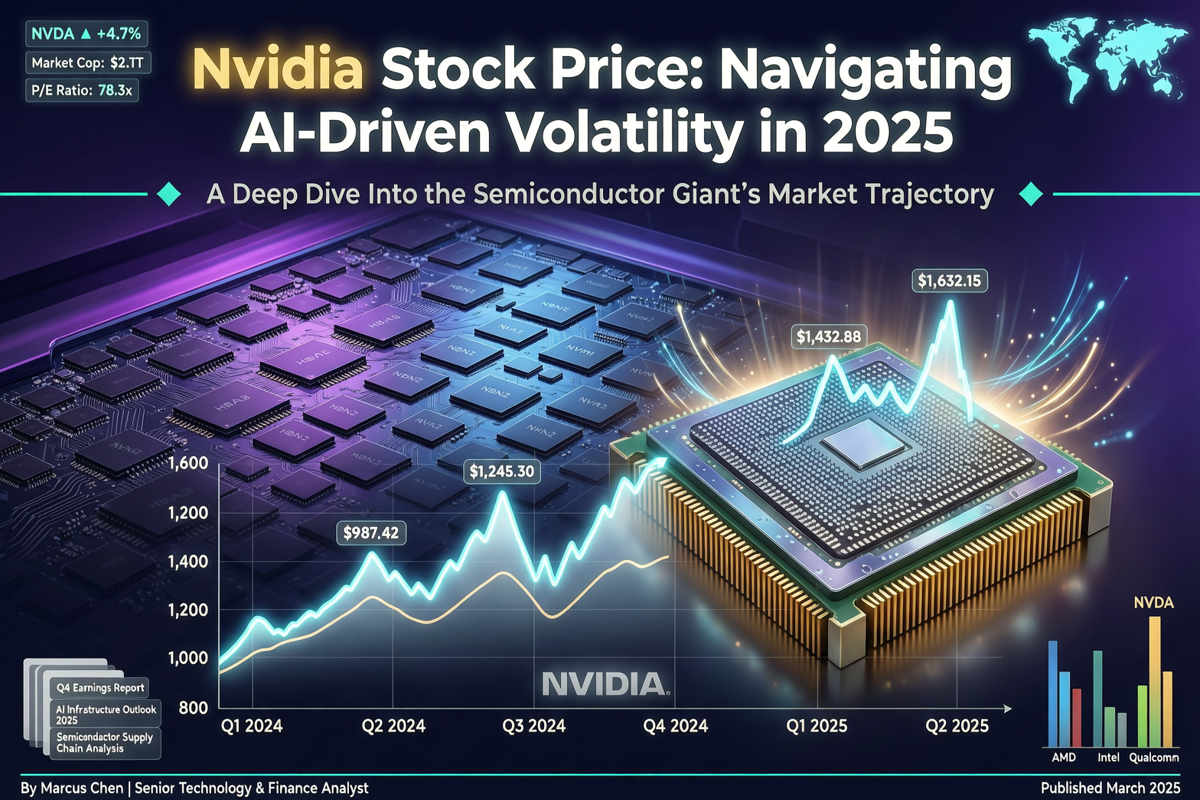
From a technical perspective, Nvidia's stock has been trading in a wide range between $800 and $1,200 in 2025. The 50-day moving average has acted as support during pullbacks, while the $1,200 level has proven to be resistance. Recent price action shows the stock consolidating around $1,000, suggesting a potential breakout or breakdown. Volume analysis indicates that institutional investors are still accumulating shares, but profit-taking occurs on rallies.
Support and Resistance Levels
- Support: $900 (200-day moving average), $800 (prior consolidation zone)
- Resistance: $1,100 (recent highs), $1,200 (all-time high)
Momentum indicators like the Relative Strength Index (RSI) have been oscillating between 40 and 70, indicating a neutral to slightly bullish trend. A break above $1,100 could signal a move to new highs, while a drop below $900 might trigger a deeper correction.
Valuation Concerns: Is Nvidia Overpriced?
Nvidia's price-to-earnings (P/E) ratio remains elevated at around 60x forward earnings, compared to the tech sector average of 25x. While high growth justifies a premium, some analysts argue that the stock is pricing in perfection. If AI spending slows or competition intensifies, the stock could face a significant revaluation. However, proponents point to Nvidia's expanding total addressable market (TAM) in AI, automotive, and gaming as justification for the premium.
Earnings Reports: The Make-or-Break Events
Nvidia's quarterly earnings reports have become major market events, often causing double-digit percentage moves in the stock. In 2025, the company has consistently beaten earnings estimates, but forward guidance has been mixed. Investors should pay close attention to revenue guidance, gross margins, and commentary on demand trends. The next earnings report, scheduled for late May, will be crucial in determining the stock's near-term direction.
Macroeconomic Factors Impacting Nvidia
Interest rate decisions by the Federal Reserve remain a key factor for growth stocks like Nvidia. Higher rates reduce the present value of future earnings and can lead to sector rotation out of high-growth names. Additionally, any signs of an economic slowdown could prompt companies to cut back on AI spending, negatively impacting Nvidia's revenue. Conversely, a soft landing scenario with rate cuts could provide a tailwind for the stock.
Investor Sentiment and Market Positioning
Retail and institutional investors alike have piled into Nvidia shares, with the stock being one of the most held in ETFs and mutual funds. Options market data shows elevated implied volatility, reflecting uncertainty about the stock's direction. The put/call ratio has been hovering around 0.8, suggesting a slightly bullish bias but with hedging activity. Social media sentiment remains positive, though some caution about a potential bubble is emerging.
Long-Term Outlook: A Buy on Dips?
For long-term investors, Nvidia's position at the center of the AI revolution makes it a compelling holding. The company's innovative pipeline, including next-generation Blackwell architecture and expansion into robotics, supports a bullish thesis. However, given the stock's high valuation and volatility, dollar-cost averaging and buying on significant pullbacks may be prudent strategies. Investors should also consider diversifying within the tech sector to mitigate risk.
Conclusion
Nvidia's stock price in 2025 is a story of AI-driven growth tempered by valuation concerns and market uncertainties. While the company's fundamentals remain strong, investors should be prepared for continued volatility. By understanding the key drivers, technical levels, and macroeconomic backdrop, traders and investors can make more informed decisions. As always, due diligence and a long-term perspective are essential when navigating high-growth stocks like Nvidia.