Preschool, Explained: What Kids Really Learn Before Kindergarten
Preschool shapes how children feel about school for years. Here's what kids really learn, how to spot a high-quality program, and what it really costs.
Ask a parent what preschool is for and you will usually get one of two answers: a place to burn off energy before kindergarten, or a high-stakes academic launchpad. Neither captures what actually happens in a good early-childhood classroom. Preschool occupies a narrow, remarkable window — roughly ages three to five — when children shift from playing alongside each other to playing with each other, and from concrete experience to symbolic thought. What happens in that window quietly shapes how a child feels about school for years afterward.
What preschool is, and what it is not
Preschool — also called pre-K, nursery school, or early childhood education — is a program for children before formal kindergarten, usually beginning around age three. It is voluntary in most places, and it is not one product. The main options look like this:
- Public pre-K, funded by states or school districts. Often free or low-cost, but seats are limited and some programs serve only four-year-olds.
- Head Start, a U.S. federal program for children from low-income families that pairs education with health screenings and family support.
- Private preschools and centers, run by nonprofits, religious organizations, or businesses, with schedules and prices that vary enormously.
- Family child care homes, small mixed-age settings where preschool and child care blend into one day.
- Parent co-ops, where families help in the classroom in exchange for lower tuition.
Schedules run from two mornings a week to full-day, year-round care. The label on the door matters far less than what happens inside the room.
What children actually learn
Social and emotional foundations
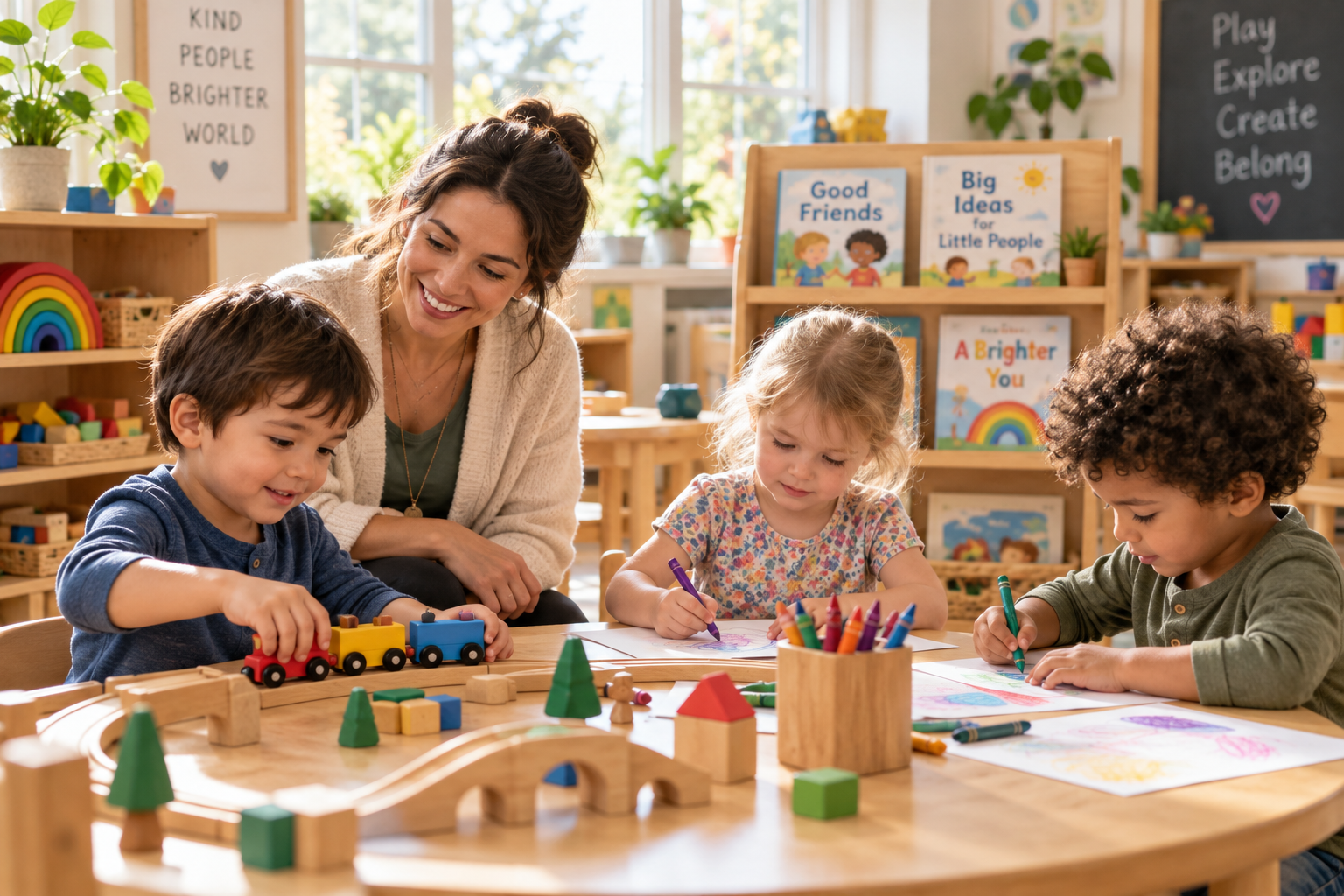
This is the heart of preschool. Children practice taking turns, joining a group, naming frustration instead of hitting, separating from a parent without falling apart, and asking an adult for help. Teachers call it self-regulation, and it is one of the strongest predictors of how a child settles into kindergarten. A child who can wait two minutes for a turn at the water table has learned something more durable than a letter of the alphabet.
Language and early literacy
Vocabulary grows through conversation, read-alouds, songs, and dramatic play. Children pick up phonological awareness — rhyming, hearing the first sound in a word — plus print concepts like reading left to right. Most preschools introduce letters and name-writing but do not teach formal reading. That is developmentally appropriate, not a shortcut.
Early math and reasoning
Counting with real one-to-one correspondence, comparing sizes, sorting by attribute, spotting patterns, naming shapes, and using spatial words like over, behind, and next to. Early math talk at this age is surprisingly predictive of later school performance, and it happens naturally while setting a table or building a ramp.
Motor skills and independence
Holding a crayon, cutting with blunt scissors, zipping a coat, opening a lunchbox, managing the bathroom. Fine motor control and self-help routines build the confidence that makes a five-year-old feel competent in a bigger building.
Play-based versus academic
The strongest programs are play-based — but guided, not放任. Teachers set up interest areas, ask open questions, and extend pretend play rather than simply supervising. The evidence generally favors playful, child-led learning at this age, and drill-style worksheets can dampen motivation before school even starts. The catch is that "play-based" is also a convenient marketing phrase. On a tour, ask what a teacher does when a child is stuck, and listen for specifics.
How to judge quality on a visit
- Ratios and group size. Fewer children per adult means more attention. Ask for the actual number on the day you would attend.
- Teacher stability and training. Ask how long staff have been there and what early-childhood credentials they hold. High turnover tells you something.
- A predictable rhythm. Children relax when they know what comes next: arrival, free play, circle, snack, outdoor time, lunch, rest.
- Conversation. Count how often adults talk with children rather than at them.
- Evidence of children. Artwork at eye level, photos of the class, names on cubbies — a room that belongs to the kids.
- Outdoor time. Daily, in almost all weather, not as a reward for good behavior.
- How conflict is handled. Watch, or ask, what happens when two children want the same truck.
Costs, waitlists, and access
Part-day programs can run from a few thousand dollars a year to well over ten thousand, and full-day care in a large city can rival a mortgage payment. Before you rule a school out on price, ask about sliding-scale tuition, sibling discounts, subsidy acceptance, and whether the local district has open pre-K seats. Waitlists at popular programs often close a year ahead, so tour early — the autumn before you need a spot is not too soon.
Red flags worth taking seriously
- Teachers who correct children with shame, sarcasm, or public scolding.
- Classrooms that are silent when you walk in.
- Screens as the default activity rather than an occasional tool.
- Vague answers about ratios, illness policy, allergies, or emergency plans.
- No outdoor space, or one used rarely.
- Staff who cannot tell you what the children did that morning.
Kindergarten readiness is not a checklist of flashcards
Readiness is mostly regulation, language, and curiosity: can the child ask for what they need, follow a two-step direction, and recover from a small disappointment? A preschooler who knows every letter but cannot enter a game of blocks is not more ready than a classmate who can. Ask any kindergarten teacher which child adjusts faster and you will hear the same answer.
What parents can do at home
Talk constantly and read aloud daily, even when it feels repetitive. Let children dress themselves badly and pour their own milk. Schedule one-on-one playdates so social skills get practice. Practice short separations before the first day. None of this requires a curriculum — it requires time and a little patience for the mess.
Preschool is not a race and not a résumé line. It is a few short years when a child learns that other adults can be trusted, that other children are interesting, and that school is a place worth going back to. Choose a program where the adults notice your child, and the rest tends to follow.