Santander's Open Banking Revolution: A New Era for Financial Services
Explore how Santander is leveraging open banking to transform customer experience, drive innovation, and reshape the future of financial services.
Introduction
Santander, one of the largest banks in Europe, is at the forefront of the open banking revolution. With a presence in over 10 major markets, the bank is leveraging open APIs to create a more interconnected, customer-centric financial ecosystem. This article explores how Santander is using open banking to enhance services, foster innovation, and set new standards for the industry.
What is Open Banking?
Open banking refers to the practice of banks sharing customer data securely with third-party providers through APIs, with customer consent. This enables fintech companies and other financial institutions to build new services, such as budgeting apps, payment initiation, and account aggregation. Santander has embraced this model, seeing it as a way to stay competitive and meet evolving customer expectations.
Santander's Open Banking Strategy
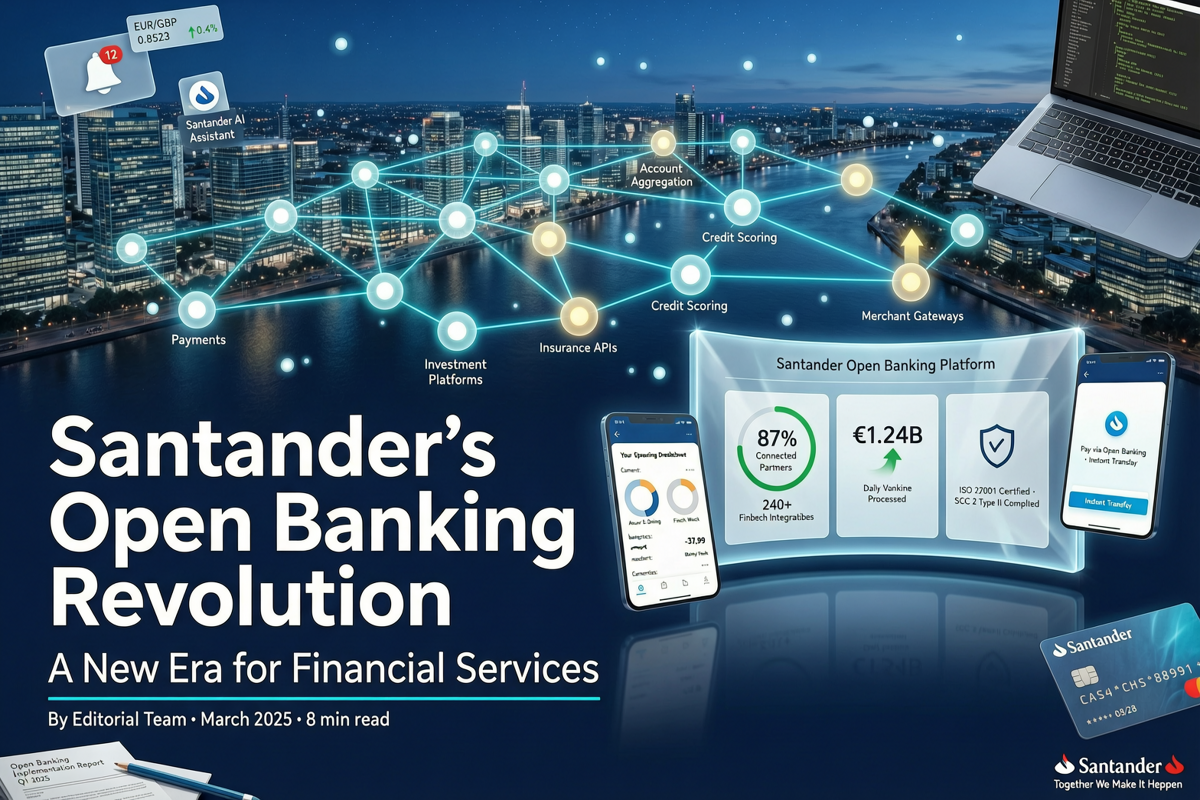
Santander's approach to open banking is multi-faceted. The bank has invested heavily in its API platform, Santander Developer Hub, which offers a range of APIs for account information, payments, and more. This platform allows third-party developers to create innovative applications that integrate seamlessly with Santander's systems. Additionally, Santander has partnered with fintech firms to co-create solutions that address specific customer needs.
Key Initiatives
- Santander Developer Hub: A central portal where developers can access documentation, SDKs, and sandbox environments to build and test applications.
- PagoNxt: Santander's global payments platform that leverages open banking to offer faster, cheaper cross-border payments.
- Openbank: Santander's fully digital bank that uses open banking APIs to provide a seamless, personalized banking experience.
- Santander X: An innovation hub that connects startups, entrepreneurs, and investors to develop open banking solutions.
Benefits for Customers
Open banking allows Santander customers to enjoy a more holistic view of their finances. Through third-party apps, they can aggregate accounts from multiple banks, track spending, and receive personalized financial advice. Moreover, payment initiation services enable faster and more secure online transactions, reducing reliance on traditional payment methods.
Impact on the Banking Industry
Santander's open banking initiatives are pushing the entire industry toward greater transparency and innovation. By sharing data securely, the bank is fostering a competitive environment where fintechs can thrive. This not only benefits consumers but also encourages traditional banks to modernize their offerings. According to a recent report, banks that embrace open banking could see a 20% increase in customer engagement and a 15% reduction in operational costs.
Challenges and Risks
Despite the benefits, open banking comes with challenges. Data privacy and security are paramount, and Santander has implemented robust measures to protect customer information. The bank also faces regulatory hurdles, as open banking frameworks vary by country. Additionally, there is the risk of increased competition from agile fintech startups. However, Santander views these challenges as opportunities to innovate and differentiate itself.
The Future of Open Banking at Santander
Looking ahead, Santander plans to expand its open banking capabilities. The bank is exploring the use of artificial intelligence and machine learning to analyze transaction data and offer predictive insights. It is also working on integrating open banking with other emerging technologies, such as blockchain and the Internet of Things (IoT). By staying at the cutting edge, Santander aims to redefine the banking experience for millions of customers worldwide.
Conclusion
Santander's open banking revolution is more than just a technological upgrade; it's a strategic shift towards a more open, collaborative, and customer-focused financial ecosystem. As the bank continues to innovate, it sets a benchmark for others in the industry. For customers, this means more choice, better services, and greater control over their financial lives. The future of banking is open, and Santander is leading the way.