Tesla's Nasdaq Rollercoaster: What 2025 Holds for TSLA
Tesla's TSLA stock on Nasdaq continues to swing wildly. This article breaks down the core drivers, analyst targets, and key levels to watch in 2025.
Tesla's 2025 Snapshot: From Highs to Lows
Tesla (TSLA) has once again earned its reputation as one of the most volatile stocks on the Nasdaq. In early 2025, shares have swung between optimism over new vehicle launches and fears about shrinking profit margins. The stock's daily moves often exceed 3% on no major news, a reflection of how sentiment-driven trading has become around this EV giant. While the Nasdaq composite has climbed to record highs thanks to AI-led gains, Tesla has struggled to keep pace, underperforming the broader tech sector in the first quarter.
The company delivered 1.79 million vehicles in 2024, a slight decline from the previous year. That reversal ended a decade-long growth streak and sent a warning shot to investors. On Nasdaq, TSLA reacted by plunging below its 200-day moving average, a key technical indicator watched by fund managers. Yet, a resilient core of retail investors continues to buy the dip, betting that Tesla's future lies beyond making cars.
Why Nasdaq Listing Matters for TSLA
Tesla has been a Nasdaq-listed company since 2010, and its inclusion in the Nasdaq-100 index ensures massive passive inflows from ETFs and index funds. When Tesla's stock sneezes, it can move the entire index, giving it an outsized influence on market sentiment. The Nasdaq is known for hosting high-growth tech names, and Tesla sits alongside giants like Apple, Microsoft, and Nvidia. This positioning gives TSLA a tech-stock premium, even though most of its revenue still comes from automotive sales.
However, Nasdaq membership also brings scrutiny. The index's rules require companies to maintain a minimum market capitalization and liquidity, which Tesla easily meets. But the broader correlation with tech-heavy funds means that when investors rotate out of growth stocks, Tesla often feels the pain first. Understanding this dynamic helps explain why Tesla's moves sometimes diverge from traditional automakers like Ford or GM.
Key Drivers Shaping the Stock
Deliveries and Price Cuts
The most fundamental driver of TSLA's stock price remains vehicle deliveries. Tesla's strategy of aggressively cutting prices to sustain volume has eroded its industry-leading operating margins, which fell from over 25% in 2022 to under 7% in early 2025. Analysts now ask whether the volume-over-profit approach actually creates long-term shareholder value. In late February, Tesla reported delivery figures that beat the lowest estimates, but the stock failed to rally significantly—a sign that the bar has been lowered too far.
Robotaxi and AI Ambitions
Tesla's long-term bulls argue that the company is not a carmaker but an artificial intelligence play. The robotaxi service, launched on a limited scale in 2024, promises a future of autonomous revenue. On Nasdaq, this narrative shows up as a premium in the price-to-earnings ratio. TSLA currently trades at over 65 times forward earnings, compared to around 20 for traditional automakers. The AI story invokes comparisons to Nvidia and other tech high-flyers, but skeptics point out that Full Self-Driving (FSD) still requires constant human supervision during testing.
Regulatory and Political Headwinds
CEO Elon Musk's political entanglements have become a direct factor in TSLA's trading. His outspoken role in government efficiency initiatives and controversial online commentary have triggered boycotts in some countries, while drawing praise from others. In Europe, Tesla sales dipped in early 2025, partly due to political backlash. Meanwhile, U.S. regulators have opened new investigations into Autopilot safety and emissions credits, creating a cloud of uncertainty. Every regulatory headline seems to cause a reflexive sell-off on Nasdaq, even if the ultimate financial impact is unclear.
Analyst Views and Price Targets
Wall Street remains deeply divided on Tesla. The average 12-month price target hovers around $285, implying modest upside from its current level of approximately $250. But the range is enormous: bull-case targets exceed $420, while bearish analysts have set targets below $120. This dispersion itself is a signal—not of disagreement, but of extreme uncertainty.
Bulls point to Tesla's energy business, which grew 40% year-over-year and is becoming a meaningful profit center. Bears highlight the aging vehicle lineup and rising competition from Chinese EV makers like BYD and NIO, which have flooded global markets with cheaper models. The upcoming Model 2 refresh, expected in late 2025, could be a pivotal catalyst. However, if it launches with aggressive pricing, margins may suffer further—creating a mixed catalyst that does not guarantee a rally.
Technical Levels to Watch
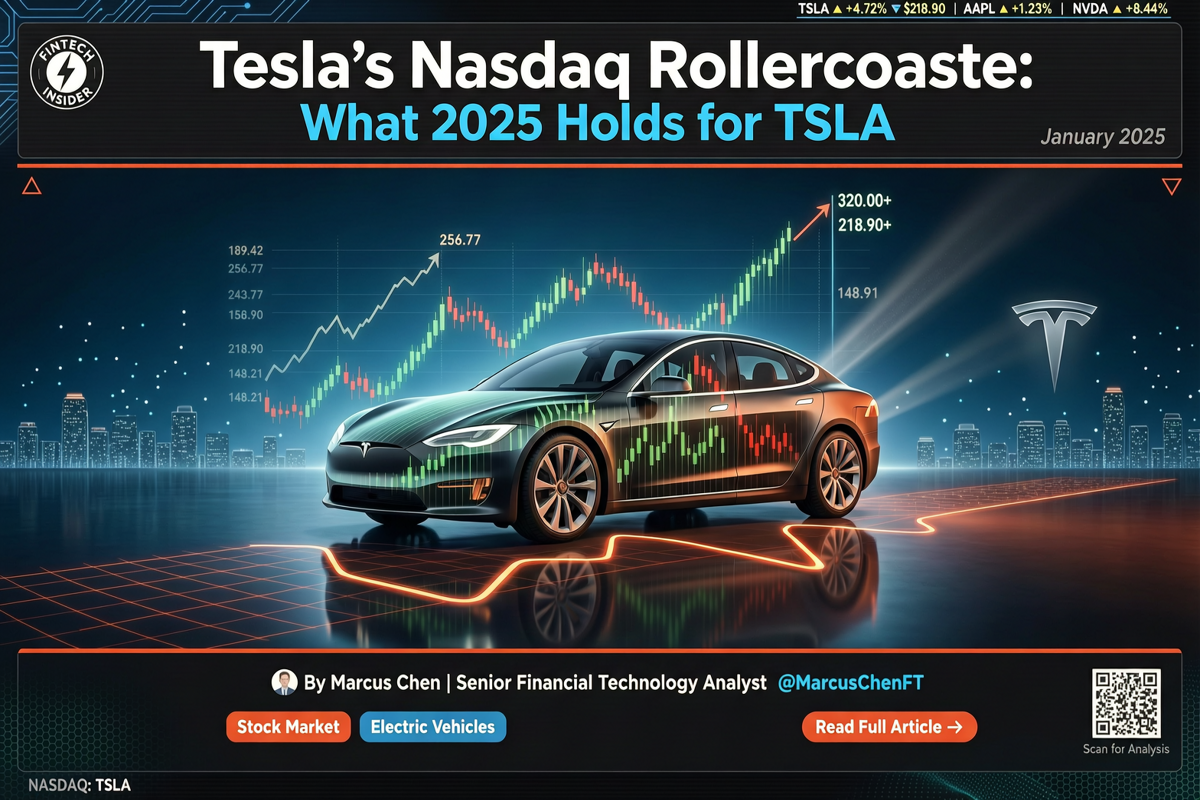
On the Nasdaq, TSLA is currently testing support in the $230–$240 zone. This area coincides with a Fibonacci retracement level from the 2024 low. A break below $230 could expose the stock to swiftly moving down toward $200, a psychological level that has held multiple times in the past two years. On the upside, the first resistance sits at $270, followed by the $300 round number, which has become a battleground for institutional traders.
Momentum indicators are mixed. The Relative Strength Index (RSI) has normalized near 50, indicating that no overbought or oversold conditions exist right now. Volume patterns suggest that institutional accumulation is slowly creeping in, but the absence of a clear fundamental catalyst means price action could remain rangebound for weeks. Traders often use options to gain leverage, with the weekly options expiry adding an extra layer of intraday volatility that can lead to sharp spikes or drops unrelated to news.
Bottom Line
Tesla's presence on Nasdaq makes it a unique hybrid: a manufacturer with tech-like valuation and meme-stock behavior. The company's future relies on transforming manufacturing capacity into AI-driven services, but execution lags have created a credibility gap. For investors, 2025 is shaping up to be a year of two possible paths. If Tesla hits its delivery growth target of 12% and makes meaningful progress on robotaxi regulatory approvals, expectations will reset higher. If those goals slip, the stock's high multiple leaves room for a severe drop back toward its 52-week low of $149.
Ultimately, TSLA demands more monitoring than almost any other Nasdaq stock. Every tweet, every delivery rumor, and every regulatory filing can move the needle. While trying to time the swings is exhausting, understanding the underlying fundamentals gives you a framework to ride the rollercoaster with a little more confidence. Whether you're a long-term believer or a short-term trader, the key is to respect the volatility and build a position that matches your risk tolerance.