S&P 500's Hidden Tectonics: The Forces Behind the Index's Moves
Discover the lesser-known dynamics driving the S&P 500, from sector rotations to passive investing and Fed policy—essential insights for investors.
The S&P 500: More Than a Number
The S&P 500 is often treated as the pulse of the U.S. stock market, a single number that supposedly tells us whether the economy is thriving or struggling. But beneath that surface lies a complex interplay of forces—some structural, some cyclical—that shape its daily and long-term movements. Understanding these hidden tectonics is crucial for anyone looking to navigate today's markets effectively.
The Mega-Cap Magnet
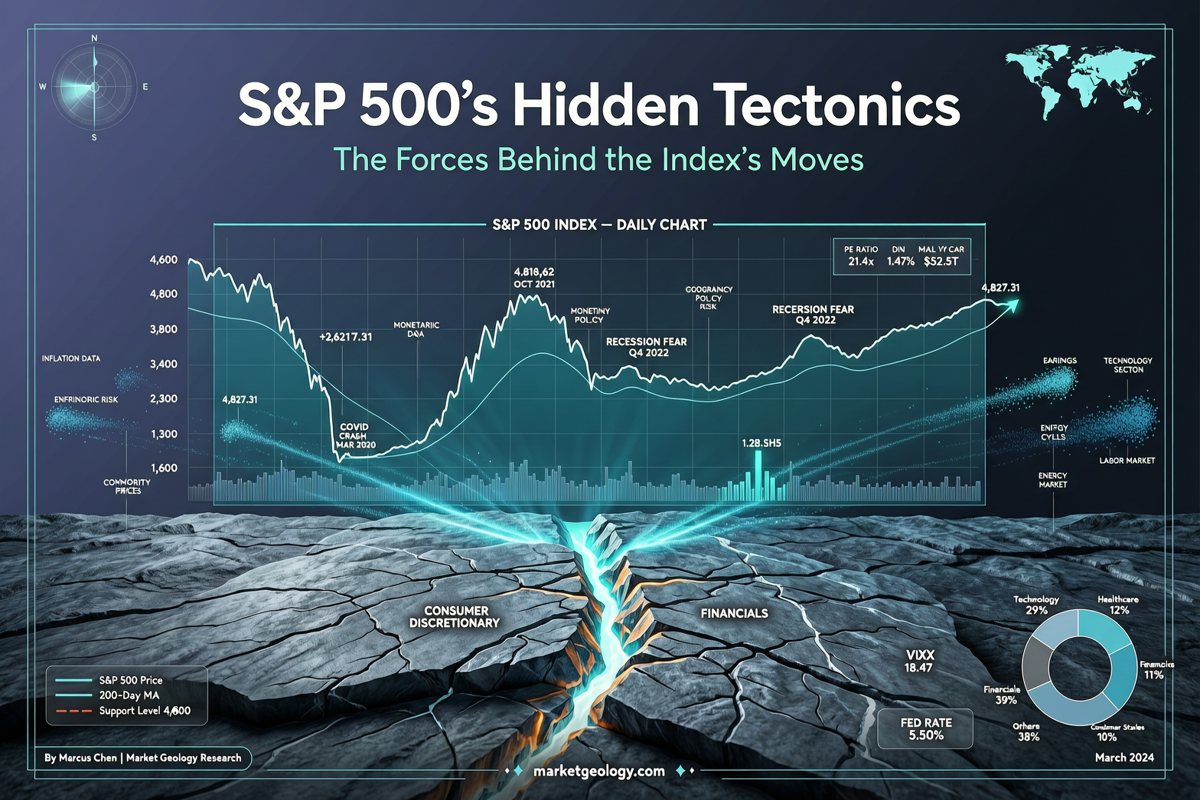
Over the past decade, the S&P 500 has become increasingly top-heavy. A handful of mega-cap technology stocks—Apple, Microsoft, Nvidia, Amazon, Alphabet, Meta, and Tesla—now account for a staggering share of the index's total market capitalization. In 2024, these seven stocks alone represented roughly 30% of the index's weight. This concentration means that the S&P 500's performance is often a reflection of what happens in Big Tech, not the broader economy.
When these giants rally, the index soars, masking weakness in other sectors. Conversely, a setback in tech can drag the entire index down, even if the rest of the market is healthy. For investors, this creates a distortion: a rising S&P 500 may not signal broad-based economic strength, but rather the dominance of a few companies with global reach and high margins.
The Passive Investing Tsunami
Another tectonic shift is the relentless growth of passive investing. Index funds and exchange-traded funds (ETFs) now manage trillions of dollars, with a large portion tracking the S&P 500. This flow has a self-reinforcing effect: as money pours into passive funds, it automatically buys the largest stocks in proportion to their weight, further boosting those mega-caps. This cycle can decouple stock prices from fundamentals, creating a feedback loop that amplifies momentum.
Moreover, passive investing reduces the pricing power of active managers, who might otherwise sell overvalued stocks. The result is that the S&P 500 becomes less efficient at reflecting true value and more responsive to capital flows. This is not necessarily a problem—until a sudden reversal triggers a cascade of selling.
Sector Rotation: The Invisible Hand
While the headline index moves, behind the scenes, money rotates between sectors. In 2023-2024, a key rotation occurred from growth to value and back again, driven by changing expectations about interest rates and economic growth. For instance, when the Federal Reserve signaled rate cuts, interest-rate-sensitive sectors like real estate and utilities rallied, while tech took a breather. Conversely, strong economic data pushed investors toward cyclical sectors like industrials and financials.
Understanding sector rotation is essential for interpreting S&P 500 moves. A flat index could hide significant shifts: energy stocks might be surging while tech drags, or vice versa. Investors who grasp these rotations can position themselves ahead of the curve, rather than simply watching the index.
The Fed's Shadow
No discussion of the S&P 500 is complete without the Federal Reserve. Central bank policy remains the single biggest external driver of index performance. Since 2022, the Fed's aggressive rate hikes to combat inflation weighed heavily on stocks, particularly growth stocks with distant earnings. But in 2024, as inflation cooled and the Fed pivoted to a more dovish stance, markets surged in anticipation of rate cuts.
The tricky part is that the S&P 500 often moves on expectations of Fed action, not the action itself. By the time the Fed announces a cut, the market may have already priced it in. This front-running behavior means that the index can rally on hints of future easing, only to sell off when the cut actually comes—a classic “buy the rumor, sell the news” pattern.
The Global Influence
Though the S&P 500 is a U.S. index, it is hardly immune to global events. The multinational nature of its components means that economic slowdowns in China, geopolitical tensions in Eastern Europe, or supply chain disruptions in Asia can ripple through corporate earnings. For example, a drop in Chinese consumer demand directly affects Apple's sales, which in turn moves the index.
Additionally, currency fluctuations matter. A strong U.S. dollar can hurt exporters' earnings, while a weak dollar boosts them. Investors often overlook this international dimension, but it is a significant lever on index performance.
The Volatility Feedback Loop
Finally, there is the role of volatility and derivative products. The CBOE Volatility Index (VIX), often called the “fear gauge,” influences how traders hedge their portfolios. Large-scale hedging can itself drive market movements. For instance, when the VIX spikes, quantitative strategies and risk-parity funds may be forced to sell stocks, exacerbating declines. This feedback loop can create sudden, sharp moves that have little to do with fundamentals.
The growth of 0DTE (zero days to expiration) options has added a new layer of intraday volatility. These short-term contracts allow traders to speculate on minute-by-minute moves, amplifying price swings. For the S&P 500, this means that quiet periods can be punctuated by sudden, unexplained jerks.
What It Means for Investors
The S&P 500 is not a monolithic entity; it is a dynamic, multifaceted index shaped by concentration, passive flows, sector rotation, Fed policy, global events, and market structure. For the average investor, the lesson is not to treat the index as a simple barometer of economic health. Instead, look beneath the surface: understand which sectors are driving gains, watch for shifts in Fed rhetoric, and be aware of the hidden feedback loops that can amplify moves.
Diversification remains key. Relying solely on an S&P 500 index fund means betting heavily on a handful of mega-cap tech stocks and the passive investing trend. Consider adding exposure to mid-caps, small-caps, international equities, or factor-based strategies to balance the risks. And always keep an eye on the tectonics—because when the ground shifts, those who see it coming are best positioned to stay steady.